The invoice on the Dunmore job went out on the 3rd. The boundary survey as quoted, plus $1,650 in additional work.
The additional work was real. The deed called for an iron pipe at the northeast corner, and the pipe was gone. The crew spent most of a second day retracing from section corners half a mile away and set a new monument. Before they did any of it, the party chief called the client from the truck, explained what they had found, and gave her a rough number. She said go ahead.
On the 9th, she calls the office. She never approved any extra work. She thought the price was the price. Nobody told her it would be more.
Your party chief remembers the call clearly. Your office manager is fairly sure there was a follow-up email. Twenty minutes and three inboxes later, you find a thread that mentions "some extra corner work." No dollar figure. No reply from the client.
You knock $825 off the invoice, send a revised copy, and quietly assume she is not coming back either way.
The short version
Survey client disputes are rarely about whether the work was done. They are about whether anyone can prove the client agreed to it. When approvals live in phone calls, texts, and scattered email, the firm loses those arguments by default. Even with modest assumptions, a six person firm can write off thousands of dollars a year in finished work, before counting the clients who do not come back. The fix is a single record of what was agreed that both sides can see.
Why do survey firms lose scope disputes they should win?
Because the burden of proof lands on the firm, and the firm usually has nothing to show.
Survey work changes after the contract is signed more than most professional services do. A monument is not where the record says it is. An encroachment turns up and needs to be located. A lender adds ALTA Table A items halfway through. A client standing on site asks the crew to stake the new fence line while they are out there.
Every one of those is a fair change and a fair charge. The trouble is how the approval happens:
- On the phone from the truck. The party chief calls, the client says yes, and nothing gets written down.
- By text. To the party chief's cell phone, never forwarded to the office.
- In an email thread. Real, but vague on the dollar amount and buried in one person's inbox.
- In person on site. The client points at the fence and says "while you're here."
That is how real work gets done, and none of it holds up when the client remembers it differently three weeks later. Usually they remember it differently in good faith. They agreed to "a little extra work." They did not agree to $1,650, because nobody wrote $1,650 down where they could see it.
What do client scope disputes actually cost?
Nobody tracks this well, including most firms about their own jobs. So here is an illustrative run at it. These are assumptions, not survey data. Swap in your own numbers.
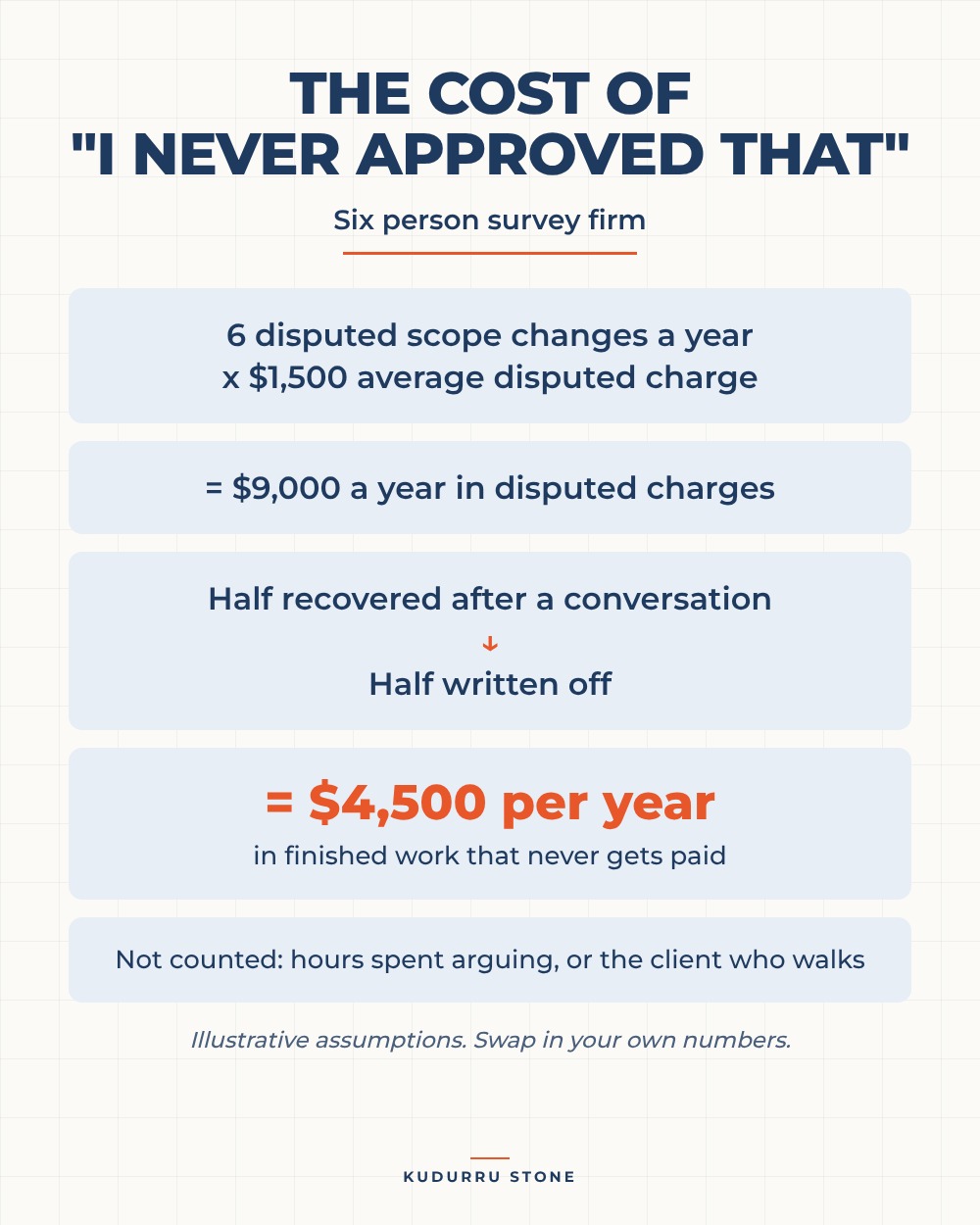
The assumptions:
- A six person firm
- Six disputed scope charges a year, roughly one every two months
- $1,500 as the average disputed amount, which covers an extra day of corner search, a re-stake, added topo, or a couple of added ALTA Table A items
- The firm recovers half on average. Some disputes get paid in full after a conversation, some get written off completely, and most get split.
The math:
- 6 disputes x $1,500 = $9,000 a year in disputed charges
- 50% written off = about $4,500 a year in completed work that never gets paid
Whether this agrees with your thoughts or not either way, it leaves out two things on purpose. It does not count the time spent arguing, digging through email, and reissuing invoices. And it does not count the client you lose. A builder or title company that sends you a steady stream of jobs and walks after one bad dispute can easily be worth more than every written-off dollar above.
You do not even have to lose the dispute to lose the client. The ones you win still leave them feeling billed for something they did not agree to.
Why does this keep happening?
Because the approval and the record of the approval happen in two different places, if the record happens at all.
The person who gets the approval is in the field, mid-job, on the phone. The person who needs the record is in the office, weeks later, building the invoice. Nothing connects them except memory and good intentions. The party chief means to email the office. The office means to send the client a confirmation. Both of them are already on the next job.
This is not a crew problem. A party chief who stops work to get the client's go-ahead is doing exactly the right thing. The process just gives that conversation nowhere to land.

What actually fixes it?
One record of what was agreed, attached to the job, that the client can see too.
Some of this you can start tomorrow, whatever software you use:
- Confirm every scope change in writing the same day, with a number. Even if the approval was verbal. "Per our call today: additional corner search at the NE corner, estimated $1,650. Reply to confirm."
- Keep the confirmation with the job file, not in whoever's inbox it landed in.
- Set a dollar threshold for signatures. Above it, the crew does not start the added work until the client has signed off.
Those habits help. They also depend on someone remembering them on a busy day, which is the same weak spot that created the problem.
The version that holds up is one where the approval and the record are the same thing.
Go back to the Dunmore job. The party chief calls from the truck and explains the missing pipe, same as before. The difference is what happens next. The office writes up the additional corner search as a change order, $1,650, tied to the project, and sends it to the client. She opens it from the email or the client portal for survey firms, reads it, and clicks approve. Her name, the date, and the exact amount she agreed to are recorded, and the change order locks. The crew starts the retrace knowing it is covered.
Three weeks later there is nothing to dispute. The invoice matches the number she approved, and either of you can pull up the approval.
That is how it works in Kudurru Stone. Change orders and additional services go out as their own quotes linked to the project, and clients can approve them line by line, so a client who wants the boundary but not the added topo can say exactly that. Once a quote is approved, it is locked. If it has to change, it goes back to the client to approve the new version. On the project itself, the budget shows the original quote, additional services, and change orders separately, each set against what has been invoiced, so you can see what was sold next to what was billed.
The point is not the software. It is that the client agreed to a specific number, in a place both sides can see, before the work happened. Whatever you use, that is the standard to hold.
The point
Clients who dispute a charge are usually not trying to cheat you. They remember a phone call differently than your party chief does, and neither side can prove anything. When nobody can prove anything, the firm eats it.
You cannot fix anyone's memory. You can make it unnecessary.
See it on your own jobs. Kudurru Stone offers a 7 day free trial of the full product. No credit card, no sales call, no demo required. Start today and put your next scope change somewhere both you and your client can see it.
If you would rather be walked through it first, book a demo and we will show you how it works on a real survey workflow.
Seven days, no credit card.
See whether it fits your firm.
Set up your first project in the time it takes to read this article.
Start Free Trial - No Credit Card