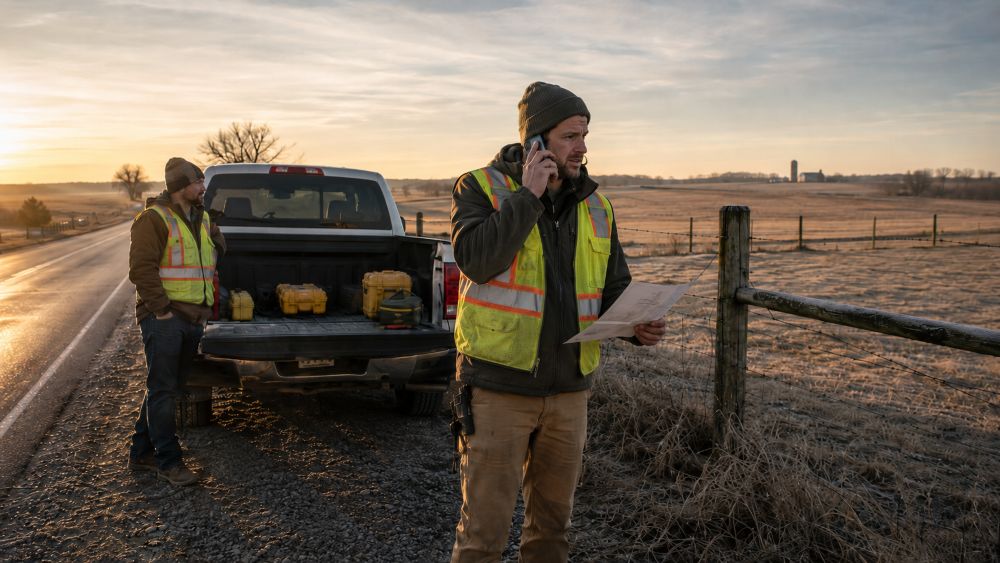
It is 7:40 in the morning. The truck has been on the road since 6:15. Your two-man crew is parked on a gravel shoulder off a county road, tailgate down, and the party chief is standing there with the plat in his hand looking at a fence line that does not match anything on the sheet.
He calls the office. It rings. He calls again. Somebody picks up and says the job got moved Thursday afternoon. The client pushed. They are supposed to be on the Henderson boundary, twenty-two miles back the other direction.
Nobody told the truck.
Where the money actually leaks
The wrong-site mobilization is rarely one big mistake. It is a handful of small, ordinary gaps that all point the same direction.
The schedule changed after the crew left the yard. Somebody took the call at 4:30, made the right decision, and updated the plan in their own head. The crew was already gone.
The reassignment happened out loud. A party chief got told in the parking lot. He heard half of it. Nobody wrote it down anywhere the other half of the firm could see.
The whiteboard is a snapshot, not a schedule. It was accurate Tuesday. It is Thursday. Two jobs shifted and one got added, and the board still says what it said.
There is nobody to call who knows the whole plan. The one person who has the real schedule in their head is on a jobsite, in a meeting, or driving.
The crew guessed. They had a parcel number, a vague location, and a deadline. They picked the one that made sense. It made sense and it was wrong.
None of these are failures of attention. Every one of them is a place where the plan lived somewhere the truck could not see it.
The math out loud
Let us walk a conservative one. Assumptions stated plainly, and deliberately on the low side.
- Two-person crew: party chief and instrument operator
- Fully burdened crew cost: $110 per hour for the pair
- Billing rate: $150 per hour for the crew
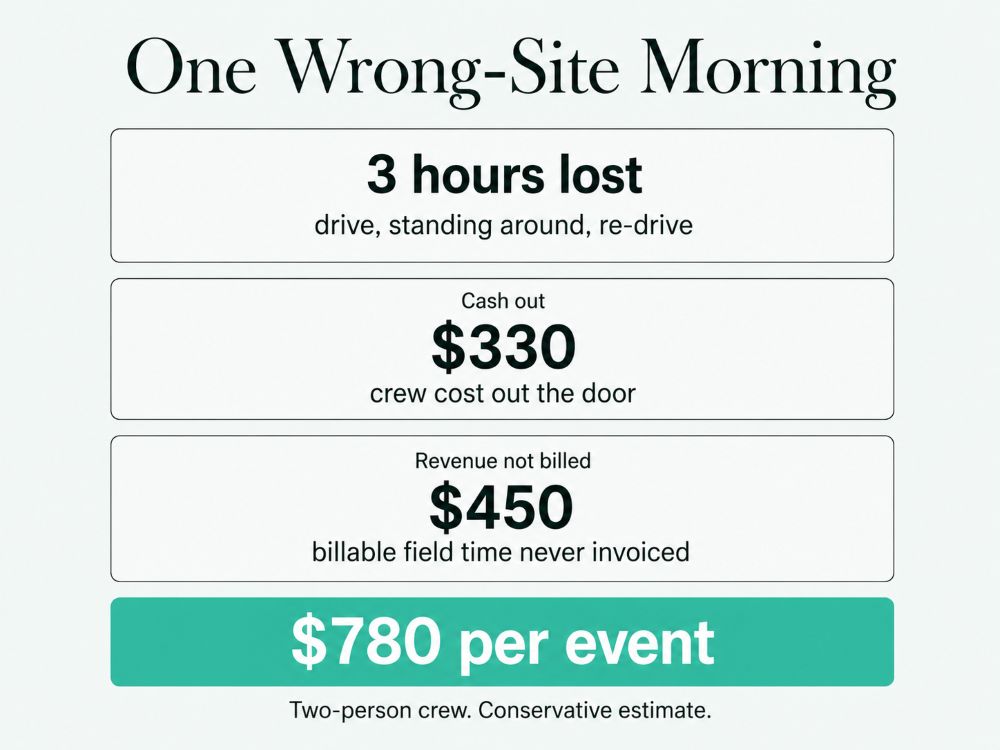
- One wrong-site event burns: 45 minutes of extra drive, 30 minutes standing around figuring out what happened, 45 minutes driving to the correct site, and enough of the morning that the day's planned work does not finish
Call it three lost hours. That is conservative. Most owners reading this are thinking half a day, and they are usually right.
Three hours of crew cost: $330 out the door.
Three hours of billable field time that did not happen: $450 that never gets invoiced.
One event: $780.
Now the honest part. How often does this really happen? Not the full disaster, the wrong county, the whole day gone. Just the version where the truck ends up somewhere it should not be, or shows up on a day nobody expected it.
Once a month is a number most owners will admit to without flinching.
Twelve events a year: $9,360.
And that is before the parts that do not fit on a spreadsheet. The client who was standing at the site at 8:00 waiting for a crew that went elsewhere. The job that slid a week because the crew never got back to it. The party chief who now double-checks every assignment by phone before he rolls, which costs you twenty minutes every single morning.
Twice a month, and you are at $18,720. Same crew. Same trucks. Same everything, except the plan reached the field.
Why it keeps happening
Here is the part worth being straight about: this is not a discipline problem, and it is not a crew problem.
Your party chief is not careless. He drove to the site he was told about, on the information he had at the time he had it. The information changed after he had it. That is the whole story.
The schedule and the crew are looking at two different things. The office is looking at the current plan. The crew is looking at the plan as it existed when they last talked to somebody about it. Every hour that passes between those two moments is an hour the plan can drift.
So the firm patches it with phone calls. Morning check-ins. Texts at 6 a.m. A party chief who calls before he turns the key. That patch works, mostly, and it costs everyone twenty minutes a day and still fails once a month when the one call that mattered did not get made.
The process is asking people to carry the schedule in their heads and pass it along by voice. People are good at a lot of things. That is not one of them, and it never has been.
What actually fixes it
The fix is not complicated, and it is not about anyone trying harder.
There has to be one schedule. Not the office's schedule and the crew's understanding of the schedule. One. When the client calls at 4:30 and the job moves, the move goes into the schedule, and the crew sees the move before the truck rolls, not after.
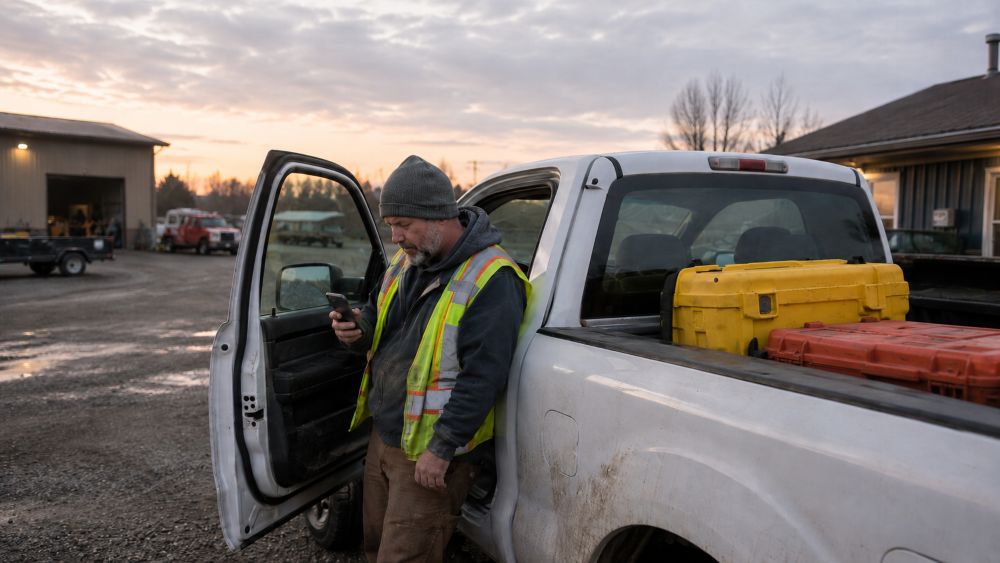
That means the crew can look at their phone at 6:00 a.m. and see where they are going today, which parcel, which client, what gear, and whether anything changed since yesterday. It means the party chief stops calling the office to confirm, because there is nothing to confirm. It means when you move a job, you move it once and it is moved everywhere.
That is what survey crew scheduling software is for. One plan, visible to the office and the field at the same time, so a change made at 4:30 on Thursday is a change the truck knows about at 6:00 on Friday.
The crew still does the hard part. They just do it at the right parcel.
The part that stings
Most owners do not track this number. It never shows up as a line item. There is no invoice that says "wrong site." It hides inside a week that felt busy and produced less than it should have.
But it is real money, and it is leaving every month. A crew standing on the wrong boundary is the most expensive thing your firm does, because you paid for all of it and billed for none of it.
You already have the crew. You already have the trucks. You already have the work. The only thing missing is that everyone is looking at the same plan at the same time.
Try it yourself. Kudurru Stone has a 7-day free trial. No credit card, no sales call, no demo required. Put next week's schedule in and see whether the truck ends up where you meant it to.
Or have us walk you through it. If you would rather see it than set it up, book a demo. Either way is fine with us.
Seven days, no credit card.
See whether it fits your firm.
Set up your first project in the time it takes to read this article.
Start Free Trial - No Credit Card

