You are cleaning out the quotes folder in December because you finally have an afternoon. Halfway down there is a proposal from early October. A residential boundary and topo for a builder you have worked with twice before. Fair price. Nothing complicated about it.
You never heard back. You also never called.
You call him now, because you are already looking at it. He is friendly about it. He tells you they went with somebody else in late October because they needed to get moving and he figured you were busy.
He was not shopping you on price. He was not unhappy with the last job. He just needed an answer sooner than you got around to giving him one, and there was nobody on your end whose job it was to notice.
The short version
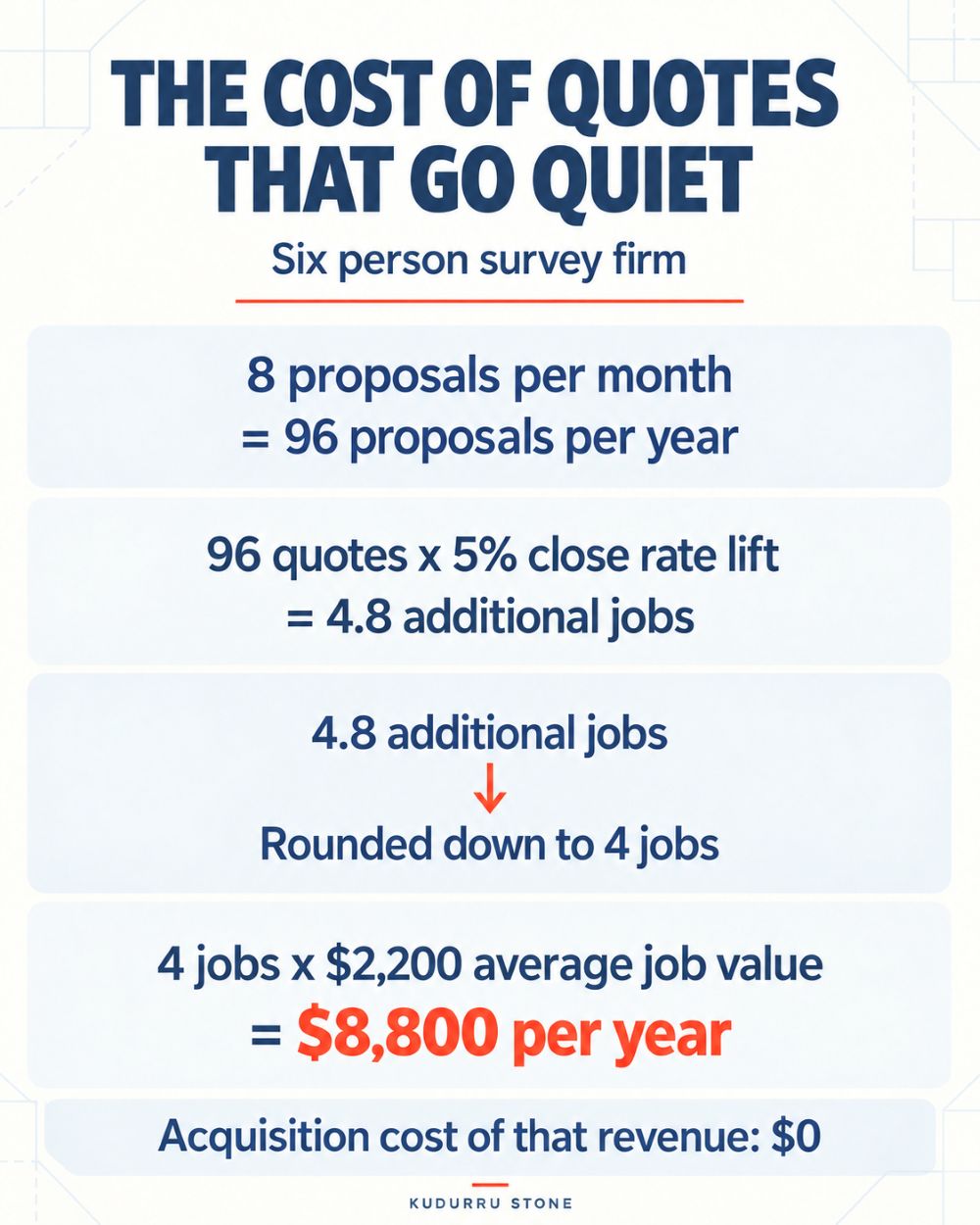
At many survey firms, a proposal leaves the active workflow as soon as it is sent. Follow-up happens only when somebody remembers to check. Consider a six-person firm sending eight quotes per month. If consistent survey proposal follow up helped that firm close four additional jobs per year at an average value of $2,200, the result would be about $8,800 in recovered annual revenue. The opportunity has already reached the quoting stage, so the additional cost of pursuing it is usually small.
Why do survey quotes go quiet?
Not because the client said no. Because nobody said anything.
Look at where your open proposals actually live right now. For most firms the honest answer is one of these:
- In the sent folder. The proposal exists as an email you sent. There is no list of open quotes anywhere, just yours or your co-workers' outlook you would have to go digging through.
- In a spreadsheet nobody opens. Somebody set it up. It was accurate for about five weeks.
- In the owner's head. Which works fine at four open quotes and fails quietly at fifteen.
None of those things will ever tell you that a proposal has been sitting for eleven days with no response. They are storage. They are not a system that puts anything in front of anyone.
So follow up becomes a memory task, and memory tasks lose to whatever is urgent. A crew that needs to be somewhere at 7 a.m. beats a quote that has been sitting quietly since Tuesday every single time, every single week.
What does missed follow up actually cost?
This calculation depends on assumptions, so treat it as an example rather than a promise. Replace the figures with numbers from your own firm.
The assumptions:
- A six person firm sending 8 proposals a month, or 96 a year
- An average job value of $2,200, which is modest for a boundary or topo and low for anything ALTA
- A close rate improvement of 5 percentage points from consistent follow up.
- 96 quotes x 5 percentage points = 4.8 additional jobs a year
Round that down to 4 jobs.
- 4 jobs x $2,200 = about $8,800 a year
Now here is the part that matters more than the figure. Look at what that revenue cost you to acquire.
Nothing. You already did the work. Somebody described the parcel to you, you looked at it, you priced it, you wrote it up, and you sent it. The client raised their hand and asked for a number. There is no advertising spend attached to that job, no networking lunch, no referral to chase. Every dollar of acquisition cost was already paid before the proposal left your office.
That is why this is the cheapest revenue a survey firm has. Not the biggest. The cheapest. Every other way you grow costs you something on the front end. This one costs a phone call on day ten.
And $8,800 is the floor. If your average job runs $3,500, or you send twelve quotes a month, or you are bidding ALTA work, the number climbs fast. Most owners who run their own figures are unpleasantly surprised.
Why does this keep happening to good firms?
For many survey firms, following up feels uncomfortable. Also, as mentioned above there is just not a good way to track it.
There is a real reluctance here that is worth naming honestly. Calling a client about a quote they have not answered feels like pestering someone. It feels like you are chasing work, and a firm with a good reputation does not like to look like it is chasing work.
But that framing is wrong, and the builder in October proves it. He did not experience your silence as professional restraint. He experienced it as you being too busy for his job. A follow up call on day seven is not a sales tactic. It is answering a question the client is already sitting with, which is whether you actually want the work.
The other half of it is the system. Nothing in the firm is designed to raise its hand. Jobs in progress have schedules, crews, and deadlines that make them visible. A sent proposal has none of that. It generates no reminder, appears on no board, and blocks nobody. It simply sits.
What actually fixes it?
The open quotes need to be visible somewhere a person looks every week, with the date they went out attached and when someone did do a follow up.
That is genuinely most of it. Not a sales process. Not a CRM discipline nobody in the office wanted. Just a list of what is outstanding, how long it has been outstanding, and what happened to it in the end, so that a quote sitting for ten days is something you can see rather than something you have to remember.
The second half is what happens when the answer is yes. A tracked proposal that becomes a real project carries its scope and its price with it, so the job that gets scheduled is the job that was sold. Handling the quote to closed project path as one continuous thing means nothing falls into the gap between winning work and starting it.
You also get something most firms have never had. A real close rate. When every quote ends up marked won or lost, you find out what percentage of your proposals turn into work, which jobs you win, and which ones you were never going to get. That is worth knowing before you price the next one.
The point
You are not losing these jobs to a competitor who was better. You are losing them to a ten day silence that neither of you meant anything by.
Pull your sent folder for the last ninety days and count the proposals that never got a yes or a no. That number is your answer.
Try it on your own quotes. Kudurru Stone offers a 7 day free trial of the full product. No credit card, no sales call, no demo required. Load in your open proposals and see what is actually sitting out there.
If you would rather be walked through it first, book a demo and we will show you how it works on a real survey workflow.
Seven days, no credit card.
See whether it fits your firm.
Set up your first project in the time it takes to read this article.
Start Free Trial - No Credit Card