
Survey client communication often comes down to one recurring question: where does my project stand? At Kudurru Stone, we hear from surveying company owners how much time it takes to answer this one simple question over and over again taking precious time away from billable hours.
It is 11:40 on Tuesday morning, and you are midway through checking a boundary sketch when the phone rings. The caller is the client on the Harper parcel. She is not angry or demanding. Her closing is next Monday, and she simply needs to tell the title company whether the plat will be ready.
You give her the best answer you have at that moment with the information you have at your disposal. It is almost finished, but you need to check with the crew before promising a date.
This is already the third status call of the morning. A builder called earlier to ask whether the crew had picked up an as-built. Then an attorney followed up on yesterday's unread email. Each person had a legitimate reason to ask, and none of the calls qualified as an emergency. Still, every interruption consumed far more than the few minutes spent talking. We call this switch tasking. Each time you switch to a different task you cost yourself and your firm time and money.
The short version
At many survey firms, a client who wants an update has only one option and that is to contact someone in the office. For a six-person firm, eight status requests per week can consume roughly 77 hours of project management time each year. At a cost of $125 per hour, that comes to about $9,625. Give clients a reliable place to check progress, and many of those calls never need to happen.
Why do clients call for status updates so often?
Usually, it is because they cannot get the information anywhere else.
After signing a survey contract, a client may hear nothing for several weeks. Did the field crew visit the property? Is the project still waiting on drafting? With a closing, lender, builder, or attorney waiting, the client is responsible for a deadline without having any visibility into the work behind it.
Calling the office becomes the natural next step. Those client update calls tend to reach the same two or three people because they are the only ones who can piece together an accurate answer.
The time loss comes from three places:
- Answering the client. The conversation may take only four to six minutes, but it usually concerns a job you were not working on at that moment.
- Finding the current status. Unless you already know the answer, you may need to open the project, find a file, ask someone down the hall, or message the party chief.
- Returning to the original work. Regaining your place takes time, especially when the interruption breaks your concentration during technical review.
The phone conversation is easy to see. The search for an answer and the effort required to refocus account for much of the hidden cost.
What do status update calls actually cost a survey firm?
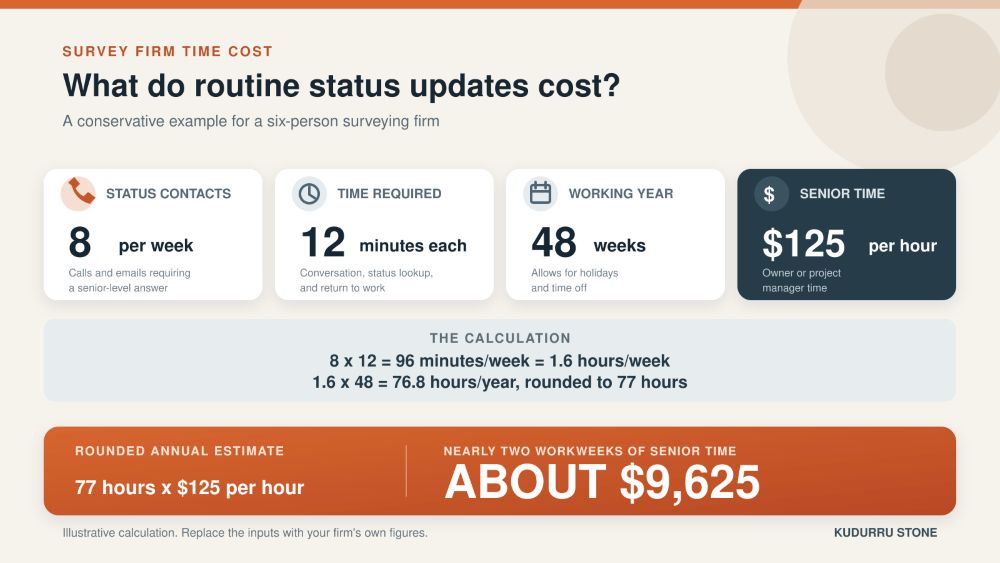
The following estimate is intentionally conservative. The assumptions are listed so you can replace them with numbers from your own firm.
The assumptions:
- A six-person firm
- Eight client status contacts per week that require an answer from the owner or another senior employee, including both phone calls and emails
- Twelve minutes per contact for the conversation, status lookup, and transition back to the previous task
- 48 working weeks per year
- A cost of $125 per hour for an owner or project manager
The math:
- 8 contacts x 12 minutes = 96 minutes per week, or 1.6 hours
- 1.6 hours x 48 weeks = 77 hours a year
- 77 hours x $125 = about $9,625 a year
To estimate the cost for your firm, use this formula:
Annual cost = (weekly status contacts x minutes per contact / 60) x working weeks x loaded hourly cost
In other words, one of your most experienced people can lose nearly two full workweeks each year answering questions clients might otherwise answer on their own.
This estimate leaves several costs out. It does not include a promised callback that slips through the cracks, a client who calls repeatedly because no one responded, or the revenue value of billable work that was interrupted. Those figures vary too widely from firm to firm.
Why does this keep happening?
Most firms never deliberately chose this process. It simply developed as the company grew.
With one or two employees, the owner may know the status of every active job from memory, making a quick phone call perfectly manageable. Once the firm has grown and managing forty open projects, that same habit turns the owner into the office switchboard. The volume changed even though the communication process did not.
The problem is also easy to overlook because no single person is at fault. One call rarely causes a bad day, and the client is usually asking a reasonable question. The cost appears only after dozens of small interruptions repeat month after month.
What actually fixes it?
Clients need a dependable way to see how their projects are progressing without locating the one person who knows.
Suppose a client can log in and confirm that fieldwork was completed on the 14th, drafting is underway, and delivery is projected for the 28th. In many cases, there is no longer a reason to call. Clients who use the information can move forward, while those who still contact you are more likely to need a decision or an explanation that deserves personal attention.
A client portal for survey firms can provide survey project status updates without creating another recurring administrative task. It displays information your office is already tracking, so no employee has to prepare a separate update or send a weekly summary. The project's existing activity becomes useful client communication.
There is another benefit that may matter just as much as the recovered time. Clients no longer feel they must chase your firm for answers. Visible progress makes the office appear organized and attentive. Repeated calls for basic information can make the same firm seem slow, even when the survey itself remains on schedule.
The point
Put routine project information where clients can see it before they reach for the phone. Each question answered there protects a little more of your team's working day.
Seventy-seven hours adds up to almost two weeks of a project manager's year. Spending twenty minutes reviewing how your firm handles status requests could be the first step toward getting that time back.
Try it with your own jobs. Kudurru Stone offers a 7-day free trial of the full product. No credit card, sales call, or demo is required. Start today and see the same project information your clients would see.
If you prefer a guided introduction, book a demo, and we will show you how it works with a real surveying workflow.
Seven days, no credit card.
See whether it fits your firm.
Set up your first project in the time it takes to read this article.
Start Free Trial - No Credit Card