
The Reynolds boundary wrapped on the ninth of last month. Corners set, monuments in, plat delivered, client happy. It is now the sixth of this month and that job has not been invoiced.
Nobody forgot it. It is on the list. It has been on the list for four weeks.
It is on the list because billing it means somebody has to sit down and reconstruct what actually happened out there. How many field days. Whether the second trip was a full day or a half. Whether the extra corner the client asked for over the phone ever got written down. Whether the crew logged the two hours they spent parked at the gate waiting on a neighbor. All of that has to become line items and get typed into QuickBooks by the one person who knows both the job and the books, and that person is currently quoting three new jobs and chasing a title company for a legal description.
So it waits. And while it waits, the client is perfectly happy and has no idea he owes you anything.
This is the most ordinary thing in the world in a survey firm. It is also one of the quietest ways money leaves the business.
Where the delay actually comes from
The delay is not laziness and it is not a billing person who is bad at their job. It comes from four specific places, and every one of them is a seam between two systems that were never connected.
The work record and the accounting record live in different places. Field time is in one system, or on paper, or in a text message. The invoice gets built in QuickBooks. Nothing moves between them on its own, so a person has to carry it across by hand.
Somebody has to reconstruct the job before they can bill it. Not read it. Reconstruct it. Three or four weeks after the fact, from field notes, a calendar, and whatever the party chief remembers. Reconstruction is slow work, and slow work gets scheduled for later.
The extras are the hardest part and the most valuable part. The return trip for the corner that got buried by the excavator. The hour spent on the phone with the county. The stakes the client asked for while the crew was already out there. These are real billable work, and they are exactly the items least likely to be written anywhere an invoice can find them.
Billing happens in batches, when there is time. Which means a job that finishes on the tenth does not get billed on the eleventh. It gets billed whenever the next billing session happens, and that session gets moved every time the field schedule gets interesting.
None of those four are a people problem. They are all the same structural problem wearing different clothes.

What the delay costs a six-person firm
Here are the assumptions, stated plainly so you can swap in your own.
A six-person firm. Two field crews, a project manager, an office administrator. Annual billings of $500,000, which is deliberately on the low side. Invoices currently go out an average of three weeks after the work is complete, when they could reasonably go out within two or three days. The firm carries a line of credit at 9 percent.
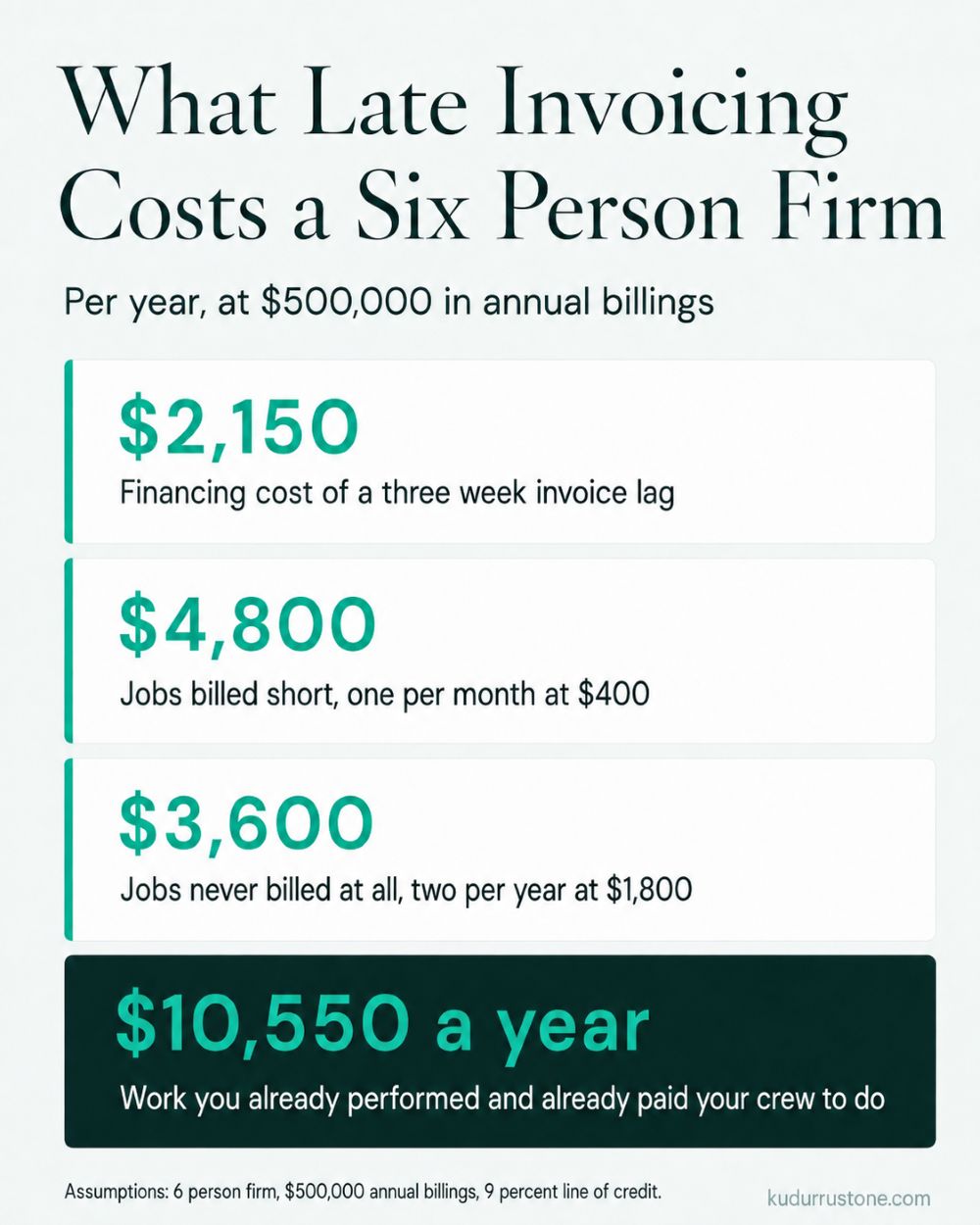
The financing cost. At $500,000 a year, one week of billings is about $9,600. Cutting three weeks of lag down to a few days means roughly two and a half weeks of billings stop sitting in limbo, which is about $24,000 that is permanently outstanding when it does not need to be. At 9 percent, carrying that gap costs about $2,150 a year.
That number alone is not going to change anyone's mind. It is the floor, not the story. The story is what happens to accuracy when billing depends on memory.
The jobs that get billed short. Say one job a month goes out missing something. A half day nobody logged, a return trip that never made the notes, an extra that got agreed to verbally and forgotten. Call it $400 per occurrence, which is conservative for a firm billing at survey rates. That is $4,800 a year.
The jobs that never get billed at all. Two a year. Small ones, the kind that finish quietly and slide off the list because they were never large enough to nag anybody. At $1,800 each, that is $3,600 a year.
Add it up and a six-person firm is looking at roughly $10,550 a year, and every dollar of it is work that was already performed. The crew already drove out there. The equipment already depreciated. The payroll already cleared.
There is a fifth cost that is harder to put a number on, so we will leave it out of the total and just name it. An invoice that arrives six weeks after the work gets questioned more often than one that arrives in three days. The client has moved on and has to be reminded what he bought. Old invoices collect slower and get disputed more, and the disputes land on the extras, which are the hardest line items to prove.
Why it keeps happening
Because the process asks a human being to be the bridge between two systems, after the fact.
That is the whole answer. The field produces a record of what happened. The books need that record in a different shape, in a different place, in different words. Between those two things there is no wire, so there is a person. And that person cannot do their bridging work until they have gathered enough information to be confident, which means billing is always waiting on somebody's memory to catch up.
It also means billing quality is highest on the jobs that just finished and lowest on the jobs that finished a month ago. Which is backwards, because the jobs that finished a month ago are the ones already costing you money by sitting there.
Firms usually respond by trying harder. A stricter billing day. A rule that field notes get turned in Friday. Those help a little, and they all decay, because they ask people to be disciplined about a handoff that should not require discipline.
What actually fixes it
The fix is not billing faster. It is removing the reconstruction step, so there is nothing to catch up on.
When field time, trips, and extras get captured against the job as they happen, the invoice is not something anyone has to build. It is already there, waiting to be sent. The half day is on the job because the crew logged it that day. The return trip is on the job because it was scheduled and recorded. The extra corner is on the job because it was added when the client asked for it, not remembered three weeks later.
That is what a working QuickBooks integration for land surveyors is actually for. Not moving data for the sake of moving data. The point is that the office stops re-keying and starts reviewing, and a job that closes on Tuesday can be billed on Tuesday, complete, without anyone hunting for what happened.
The difference the owner feels is not a report. It is that the pile stops existing.
The jobs that bill themselves
Every firm has a few jobs that go out clean and on time. Usually the simple ones, the ones with no extras and one field day, where there was nothing to reconstruct because there was nothing complicated to remember.
Those are not your best jobs. They are just your best documented ones.
The work is already done. The money is already earned. The only thing standing between the two is a record that has to be rebuilt from memory before anyone can send a bill. Fix the record and the delay goes away on its own.
Try it on your own jobs. Kudurru Stone offers a free trial. No credit card, no sales call, no demo required. Set up a live job, log a field day against it, and see what the invoice looks like at the end.
Would rather be walked through it? Book a demo and we will show you how billing works with your kind of jobs.
Seven days, no credit card.
See whether it fits your firm.
Set up your first project in the time it takes to read this article.
Start Free Trial - No Credit Card