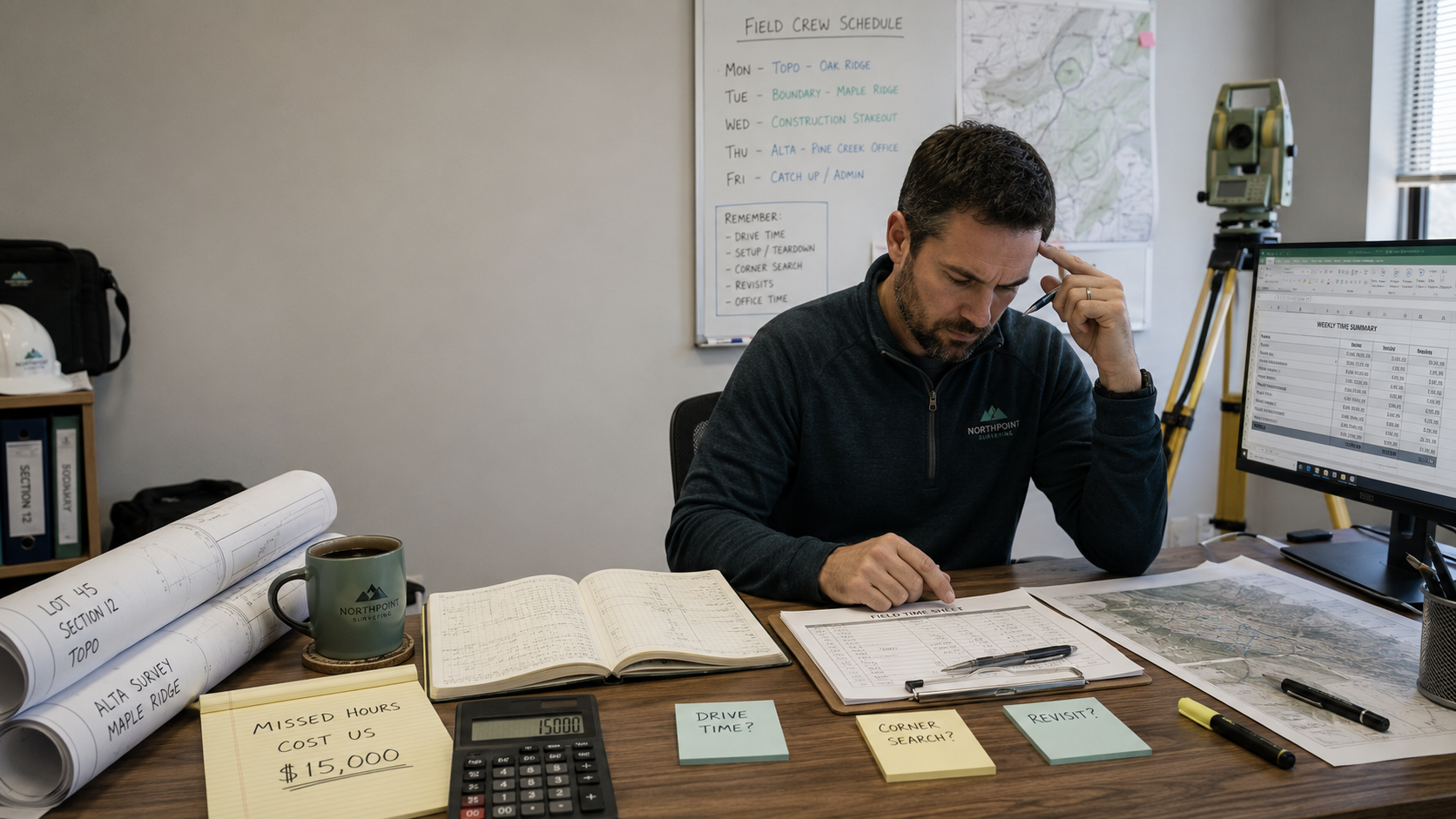
Your crew worked a full day. The question is whether all of it made it onto an invoice.
Picture a normal Tuesday. The crew heads out early, spends the morning on a boundary survey, breaks for lunch, then loses an hour in the afternoon relocating a corner that turned out to be under six inches of fill. They wrap up, drive back, and the day is done. Later that week, the party chief fills in the hours from memory. Most of it is right. But that extra hour spent chasing the buried corner? It gets rounded off, or forgotten, or folded into a number that feels about right. It never lands on the invoice.
Nobody notices. Nobody is counting. And that is exactly the problem.
Where the hours actually go missing

Unbilled field hours are rarely lost all at once. They leak, a little at a time, in places that are easy to overlook.
Hours logged from memory days later are the biggest source. When a crew reconstructs the week on Friday afternoon, the details soften. A two-hour task becomes "about an hour and a half." The corner search gets absorbed into the drive time. None of it is dishonest. It is just how memory works when you are asking someone to account for four days ago.
Travel and mobilization time is another quiet leak. The crew is on the clock the moment they load the truck, but that time often does not make it onto any job. It sits in a gap between "leaving the office" and "starting the survey," and firms bill for neither.
Then there is rework. A re-visit to a site because a monument was disturbed, a return trip for a line that did not close, an extra hour because the utility locate was wrong. These hours are real, they were worked, and they frequently get eaten rather than billed, because tying them back to the original job after the fact takes effort nobody has time for.
Add it up and you have a steady gap between what the crew actually did in the field and what the office actually puts on a bill.
Let us do the math
Take a firm with one field crew, in a shop of about six people. That is close to the average size for a land surveying firm.
Say that crew loses just two unbilled hours a week. Not two hours a day. Two hours across the whole week. That is a conservative number. Most firms who start tracking this closely find it is worse.
At a billing rate of $150 an hour, two hours is $300 a week. Over a 50-week working year, that is $15,000. Gone. Not from work you did not do, but from work you did and never charged for.
Now run a firm with two field crews. Same modest assumption, two lost hours per crew per week. That is $30,000 a year walking out the door.
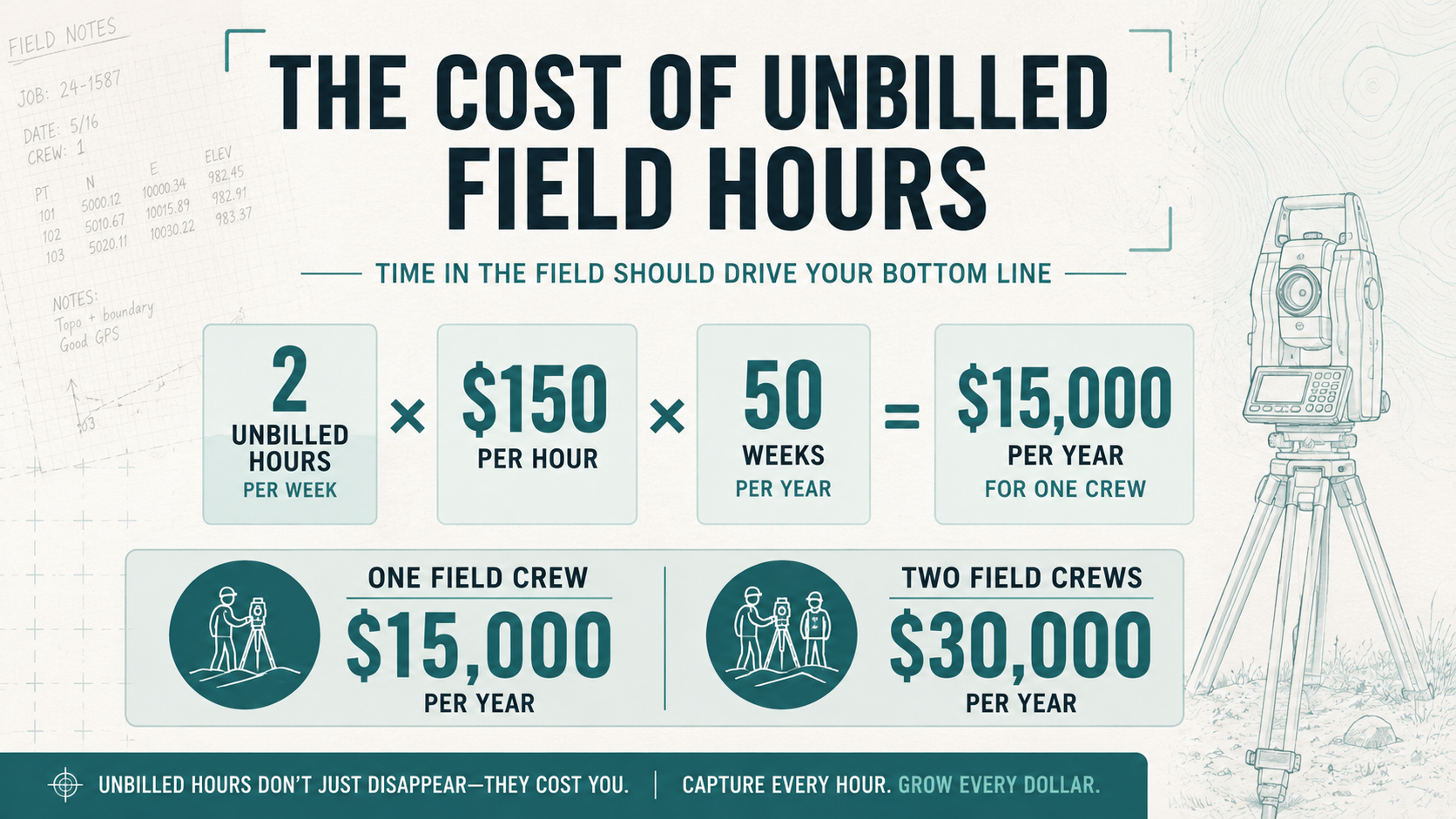
These are deliberately cautious figures. If your reaction is "two hours is low, ours is worse," that is the point. The real number at most firms is higher, because the hours leak in more places than anyone tracks. And $15,000 is not a rounding error. For most small firms, it is a new truck, a raise, or the entire cost of the systems that would have caught it.
Why this keeps happening
The instinct is to blame the crew. That is the wrong target.
The problem is the process, not the people. Most firms track field time with the tools they have always used: memory, a whiteboard in the shop, a spreadsheet someone fills in at the end of the week. Every one of those depends on a person reconstructing what happened after it already happened. You are asking a party chief who spent the week in the field to become an accountant on Friday.
People are excellent at running a survey. They are not built to be a stopwatch. When the system relies on end-of-week recall, the hours that get remembered are the obvious ones, and the ones that get lost are the small, irregular, easy-to-forget ones. Which happen to be the exact hours that add up to $15,000.
What actually fixes it
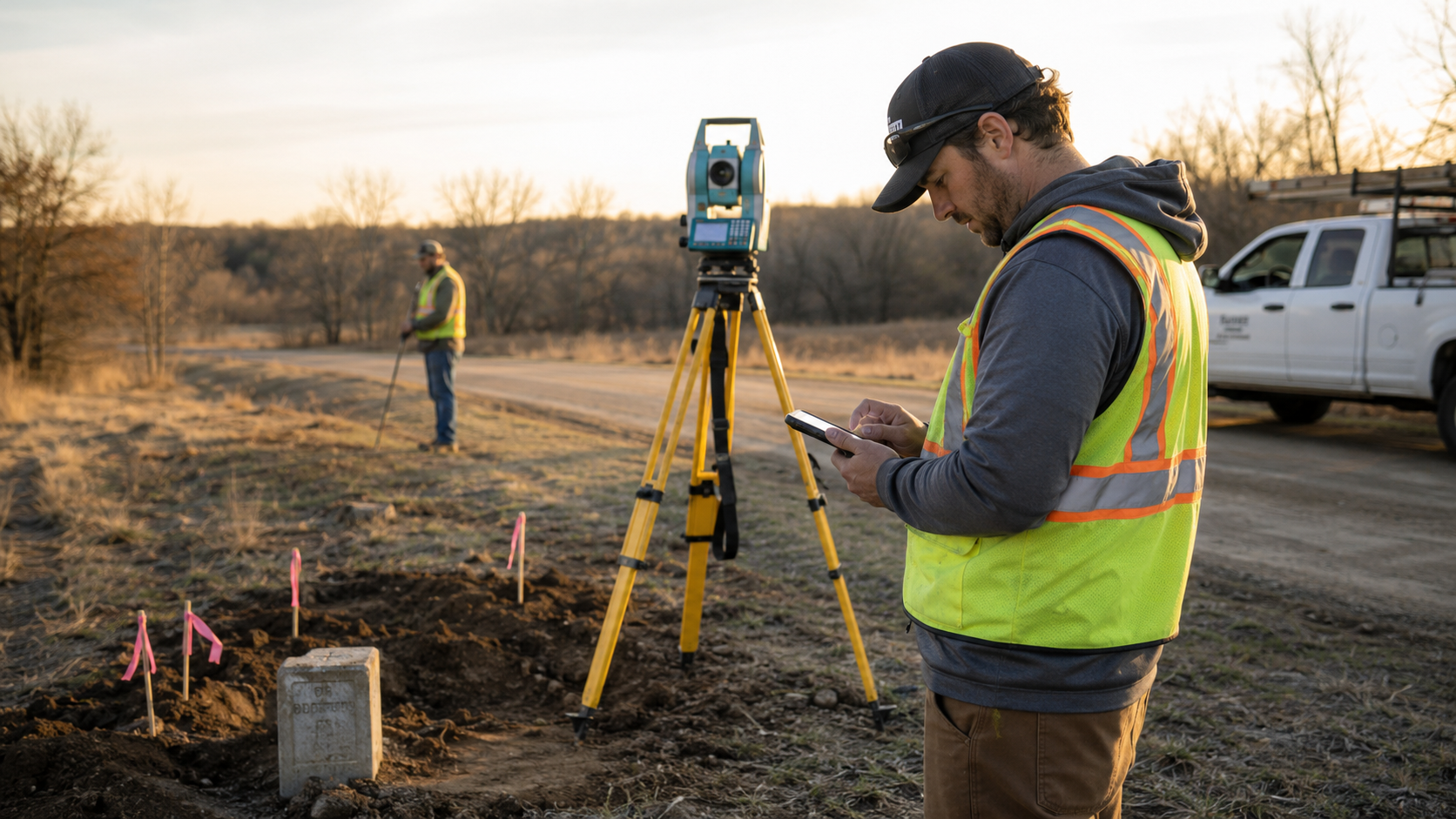
The fix is not asking your crew to try harder to remember. It is removing the need to remember at all.
When field hours are captured as the work happens, tied to the job while the crew is still on site, the reconstruction problem disappears. The corner search gets logged when it happens, against the job it happened on. Mobilization time is on the clock and on the record. The re-visit is tied back to the original project automatically. By the time the day is over, the hours are already accounted for, already attached to the right job, and already ready to become an invoice.
No Friday scramble. No reconstructing the week. No quiet gap between what the crew did and what the office bills. This is exactly what time tracking for survey crews is meant to solve, capturing the work as it happens so nothing has to be remembered later.
The hours are already yours
Here is the part worth sitting with. This is not money you have to go out and earn. The work is already being done. Your crew is already in the field putting in the hours. The only question is whether those hours make it onto the bill or slip through the gap.
You can keep reconstructing the week from memory and accepting the leak as a cost of doing business. Or you can capture the next field day as it happens and find out how much you have been giving away.
Start a 7-day free trial and track your next field day the moment it happens. No credit card, no sales call. If you would rather be walked through it first, book a demo and we will show you how it fits your firm.
Seven days, no credit card.
See whether it fits your firm.
Set up your first project in the time it takes to read this article.
Start Free Trial - No Credit Card