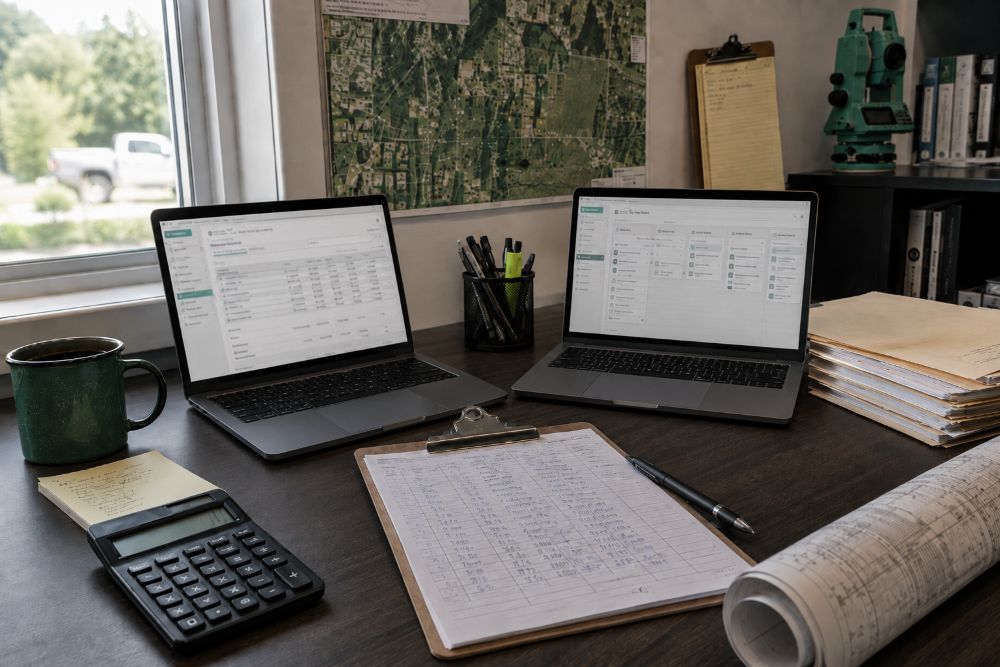
Double Entry Is Quietly Costing Your Office a Day a Week
It is Tuesday morning. The Hollis lot split closed out last week, and the person who runs your office is entering it into QuickBooks. Client name. Address. Job number. Four line items copied off the field record.
All of that already exists. It was typed once when the job was opened, and it is being typed again now, because the system that knows the job and the system that sends the invoice have never been introduced.
Partway through, she notices something. Last month's Kestrel invoice went out with a job number one digit off from the one on the field record. Not a disaster. It means the check came in, did not match anything, and sat unapplied for three weeks. Now it is a fifteen minute detour to sort out.
She sorts it out. She finishes the Hollis invoice. Then she opens the next one and does the whole thing again.
Nobody in the firm calls this a problem. It is just Tuesday.
Every number in your firm lives in two places

Most survey firms are not running one system. They are running two, and a person in the middle holding them together.
The field record knows the job. Who went out, which days, how many hours, the mileage, the corner the client added over the phone, the plat fee, the receipt for the county copies.
The books know the money. The customer, the invoice, the payment, the payroll.
Both records are true. Neither one is aware the other exists. So somebody reads the first one and types it into the second one, over and over, all year.
Here is where the duplication actually happens in a survey firm:
- Opening a job. New client and new job get set up in the field system, then set up again in QuickBooks as a customer and a job so costs have somewhere to land.
- Field time. Crew hours get entered once so the job is costed and billed correctly, and again so payroll runs. Same hours, two destinations.
- Job expenses. Recording fees, monuments, county copies, subconsultant invoices. Coded to the job in one place, coded again in the other.
- Building the invoice. Someone reads the field record, works out what is billable, and re-keys it as line items.
- Month end. Job costs in one system get compared against the books to see whether they agree, and they rarely agree perfectly.
- Cleanup. Finding the mismatch. A wrong job number, a day entered twice, a rate that was updated in one place and not the other.
None of that is difficult work. That is exactly why it never gets examined. Every piece of it is small enough to just do.
What the bridge actually costs
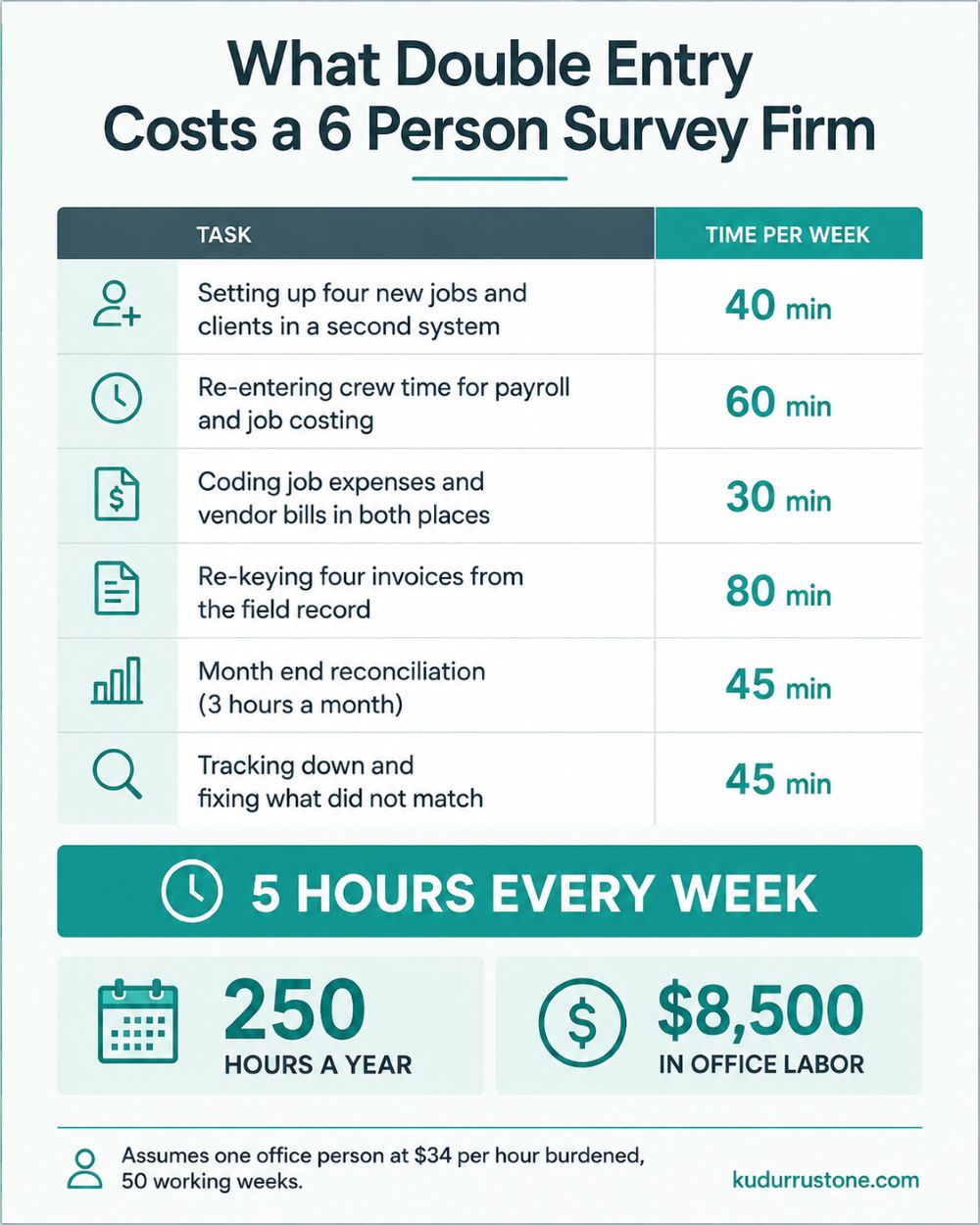
Let us put a number on it, conservatively, for a firm most owners will recognize.
The assumptions:
- Six people. One person handling the books and the billing, one owner or manager, two field crews.
- About sixteen jobs opened and sixteen invoiced per month. Call it four a week.
- Office labor at $34 per hour, fully burdened. That is roughly a $26 hourly wage plus payroll taxes and benefits. This is a cost figure, not a billing rate, so it is deliberately low.
Now the week:
| Task | Time per week |
|---|---|
| Setting up four new jobs and clients in a second system | 40 minutes |
| Re-entering crew time for payroll and job costing | 60 minutes |
| Coding job expenses and vendor bills in both places | 30 minutes |
| Re-keying four invoices from the field record | 80 minutes |
| Month end reconciliation (3 hours a month) | 45 minutes |
| Tracking down and fixing what did not match | 45 minutes |
| Total | 5 hours |
Five hours a week. Fifty working weeks. That is 250 hours a year, and at $34 per hour it is $8,500 of office labor spent moving numbers from one screen to another.
Two things about that figure are worth sitting with.
The first is that 250 hours is more than six full work weeks. One person in your office spends the equivalent of a season doing data entry that produces nothing new. The job was already recorded. The work was already done. This is the cost of writing it down a second time.
The second is that $8,500 is the polite version. It assumes nothing goes badly wrong. It does not count the invoice that goes out with a wrong number on it, the client call that follows, or the credit memo. And it does not count what your office manager would do with six weeks a year if she were not typing. In most firms that is chasing receivables, which is the highest paying work in the building.
If your firm runs more than sixteen jobs a month, and plenty of six person firms do, the five hours is a floor and not a ceiling.
Why it keeps happening
Nobody chose this. That is the part worth being clear about.
No survey firm sits down and decides to run two disconnected systems. The firm gets QuickBooks early, because every business needs books. Then it grows, and the whiteboard and the spreadsheets stop holding, so it gets something to track jobs and crews. Two good decisions, made years apart, for two different reasons.
What never happened was anyone deciding who would connect them. So the connection became a person, by default. A person is a good bridge in one respect, which is that a person catches things a system would not. A person is a poor bridge in every other respect. A person is slow, a person is expensive, a person types the occasional wrong digit, and when a person is out for a week the bridge is closed.
This is not a discipline problem or a hiring problem. Your office manager is not doing this badly. She is doing it as well as it can be done by hand, which is why nobody notices what it costs.
What actually fixes it
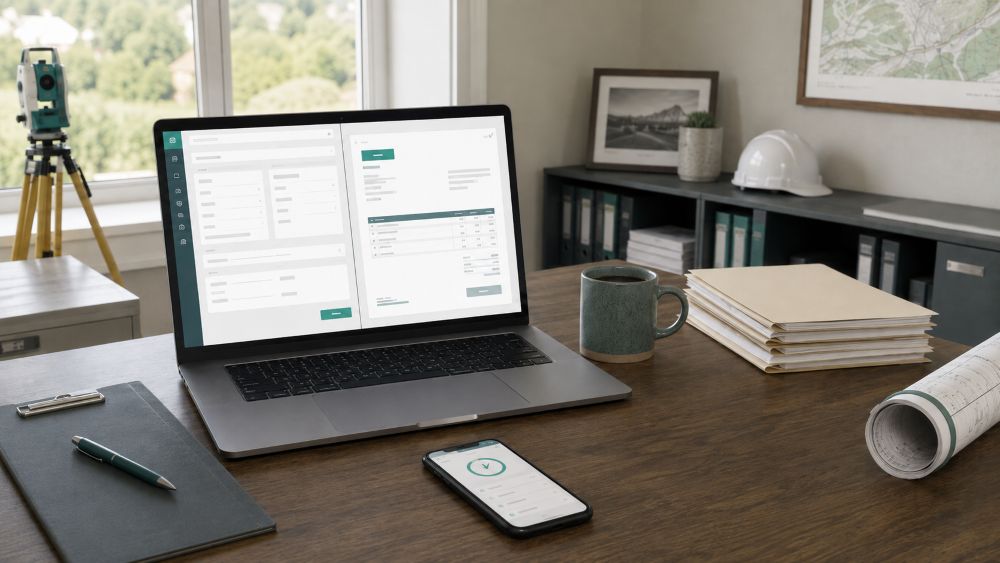
The fix is not a better process for typing things twice. It is entering the job once and having the books already know about it.
That means the crew's hours land against the job when they are recorded, not when someone re-types them. It means job expenses are coded to the job the first time, by whoever entered them. It means the invoice is built from the record of what actually happened, so the line items are already there and the job numbers already agree. And it means month end is a review instead of an investigation, because there is nothing to reconcile when both sides came from the same entry.
That is the job QuickBooks integration for land surveyors is meant to do. Not replace your books, and not ask your office to learn accounting over again. Just close the gap between the record of the work and the record of the money, so nobody has to stand in it.
The measure of whether it is working is simple. Your office manager should never type the same job number twice.
The part that is easy to miss
Late invoices get noticed. A client who has not paid in ninety days gets noticed. Double entry never gets noticed, because it is finished every week. The invoices go out. The books balance. Nothing is on fire.
But six weeks a year of one person's time is real money, and you are spending it to produce a copy of something you already had. That is the whole trade. You are paying an experienced person to be a photocopier.
Take one week and have whoever does your books tally the time on a sticky note. Not an estimate. Most owners find the number is higher than five hours.
Want to see what the office side looks like when the job only gets entered once?
Start a 7 day free trial of Kudurru Stone. No credit card, no sales call, and you do not have to talk to anyone to get in. Set up one real job and run it through the way you actually work.
If you would rather be walked through it, book a demo and we will show you how the billing side fits your workflow.
Seven days, no credit card.
See whether it fits your firm.
Set up your first project in the time it takes to read this article.
Start Free Trial - No Credit Card

